work
Raymond E. Mingst’s interdisciplinary practice spans ephemeral action, object-making, and installation. Across these forms, he returns to the question of how memory is carried—and what resists preservation. From early site-based gestures to reliquaries composed of humble materials, archival interventions, and installations, the work establishes conditions for mourning, devotion, and the reanimation of memory.
These sections follow a loose chronology, while the approaches they describe recur and overlap.
1. ephemeral acts/early interventions
This early body of work emerged from an impulse toward impermanence. Created in natural environments and often intentionally undocumented, these gestures took shape within the context of cultural loss—particularly the HIV/AIDS crisis.
The decision not to preserve the work functioned as a refusal of stewardship. Shaped by grief, these temporal acts depart from the logic of legacy and endurance. They foreground process, transience, and the conditions of their own making.
Later experiments in unstable media—blueprints, found documents, organic matter—extend this attention toward temporal fragility. What remains is often partial or unstable.




2. devotional forms
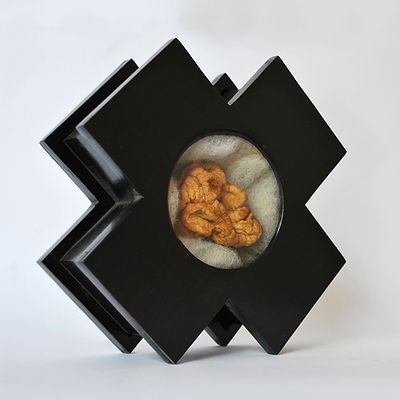
Here, attention turns to the object—small-scale, handcrafted, and symbolically charged. Materials such as dried apple heads, wax, gauze, and carved wood recur throughout the series.
Drawing from vernacular craft traditions, religious relics, and mourning practices, these works treat acts of making as forms of reverence through which humble materials gather meaning.
3. documentation & remembrance
Including The Department of Reparative History
Organized around questions of historical omission, visibility, and queer representation, The Department of Reparative History functions as an ongoing structure for engaging queer archival material—particularly gay pornography, pulp literature, and popular media—in relation to loss and recovery in the wake of the HIV/AIDS pandemic.
Across artist books and installations, this work develops alternative modes of commemoration that acknowledge the partial, disrupted, and uneven nature of the archive, marked not only by the loss of artists, but of the broader constellations that once made their work visible.


4. recent work & inquiries
Recent projects continue this sustained inquiry into loss, memory, and the poetics of absence.
In Erasure Gallery, photographic portraits are printed on fabric banners measuring 3 × 6 feet, echoing the dimensions of the AIDS Memorial Quilt. The work does not replicate the Quilt’s function, but enters into relation with it—drawing on its scale and presence while shifting attention toward what remains unresolved or unrecorded.